10 Years of Impact

Lawyers for Good Government2016 — 2026

Large numerals “10” entwined with the L4GG torch-and-pen mark

Lawyers for Good Government mobilizes lawyers to ensure that all levels of government — federal, state, and local — promote equal justice under the law and uphold civil and human rights, including the right to health and the right to live in a healthy environment.

From the Executive Director

Traci Feit Love
Traci Feit Love

Founder, President, and Executive Director
Lawyers for Good Government

Dear L4GG Supporter,

Everything about this organization should have been impossible.

In November 2016, I was frightened by what I saw coming for our country. I was a lawyer, with no funding, no staff, and no plan. All I had was a Facebook post and the conviction that the legal profession owes something not only to its clients, but also to the public. Within days, I found that thousands of lawyers agreed with me. That was the first impossible thing we did. It wasn’t the last.

Ten years later, that post has become a national force: a community of 125,000 legal professionals and activists, more than $200 million in pro bono legal services, and 63 full-time staff working alongside thousands of volunteer attorneys. Our work now spans three issue areas: Democracy and the Rule of Law, Civil and Human Rights, and Climate Change and Environmental Justice.

No one handed us a blueprint. We built one.

It starts from a simple premise. Lawyers draft, interpret, and enforce the law. That gives us not only the power to help, but also the responsibility to make sure our laws are fair and just. So L4GG finds the places where lawyers can make the greatest difference, and then we build the infrastructure that lets lawyers work at scale.

That is how impossible things keep happening here. Our volunteers have defended federal climate funding promised to communities. They have won the release of immigrants held in detention and shielded the medical records of thousands of transgender youth from federal overreach. We use technology to multiply every volunteer hour, and we build legal power around the priorities of the communities we serve.

And something changes in the lawyers who join us. Once they see firsthand how bad policy and injustice affect real people, many become advocates for life. They are the engine of this organization.

This moment calls on us to defend what is under attack, restore what has been lost, and fix what never really worked in the first place. None of that ends with a single election. It demands sustained action over the years to come, and L4GG is built for it.

To everyone who has been part of this story, whether you engaged with that first post, took your first pro bono case with us this year, gave what you could, or cheered us on along the way: thank you. You made the impossible possible.

We spent 10 years proving what lawyers can do. Imagine what the next 10 years will bring.

In solidarity,

Signature of Traci Feit Love

10 Years of Breaking the Pro Bono Mold

Impossible

Every program begins with a problem that looks too big, too risky, or not in our lane. Promised funding stays out of reach. Rules are too complex to untangle alone. Fear and hostile policy leave individuals, communities, and institutions without protection. We name the obstacle plainly before we try to move it.

Possible

Then we find the leverage point, the place where legal skill can change the outcome. We build what lawyers need to act: training, technology, partnerships, and supervision. We mobilize our network to do the work, from legal guidance to direct services to litigation. The proof is in the impact — and in the people, communities, and institutions that we’ve served.

Repeatable & Scalable

Then we make it travel. Every model we build is designed to be reused, so no attorney starts from scratch and no new crisis starts from zero. The only way to meet today’s multitude of problems is to learn and scale, so we can reach more clients; engage more attorneys in pro bono work; and serve more organizations, communities, and governments.

10 Years of Building Infrastructure So Lawyers Can Act When Justice Needs Them Most

L4GG has become a national engine of pro bono legal power. Our programs range from national mobilizations that move thousands of lawyers at once to holistic one-on-one representation for a single client in crisis.

All of it is organized under three intersectional pillars of work: Democracy and the Rule of Law, Civil and Human Rights, and Climate Change and Environmental Justice. The scale of our impact speaks for itself.

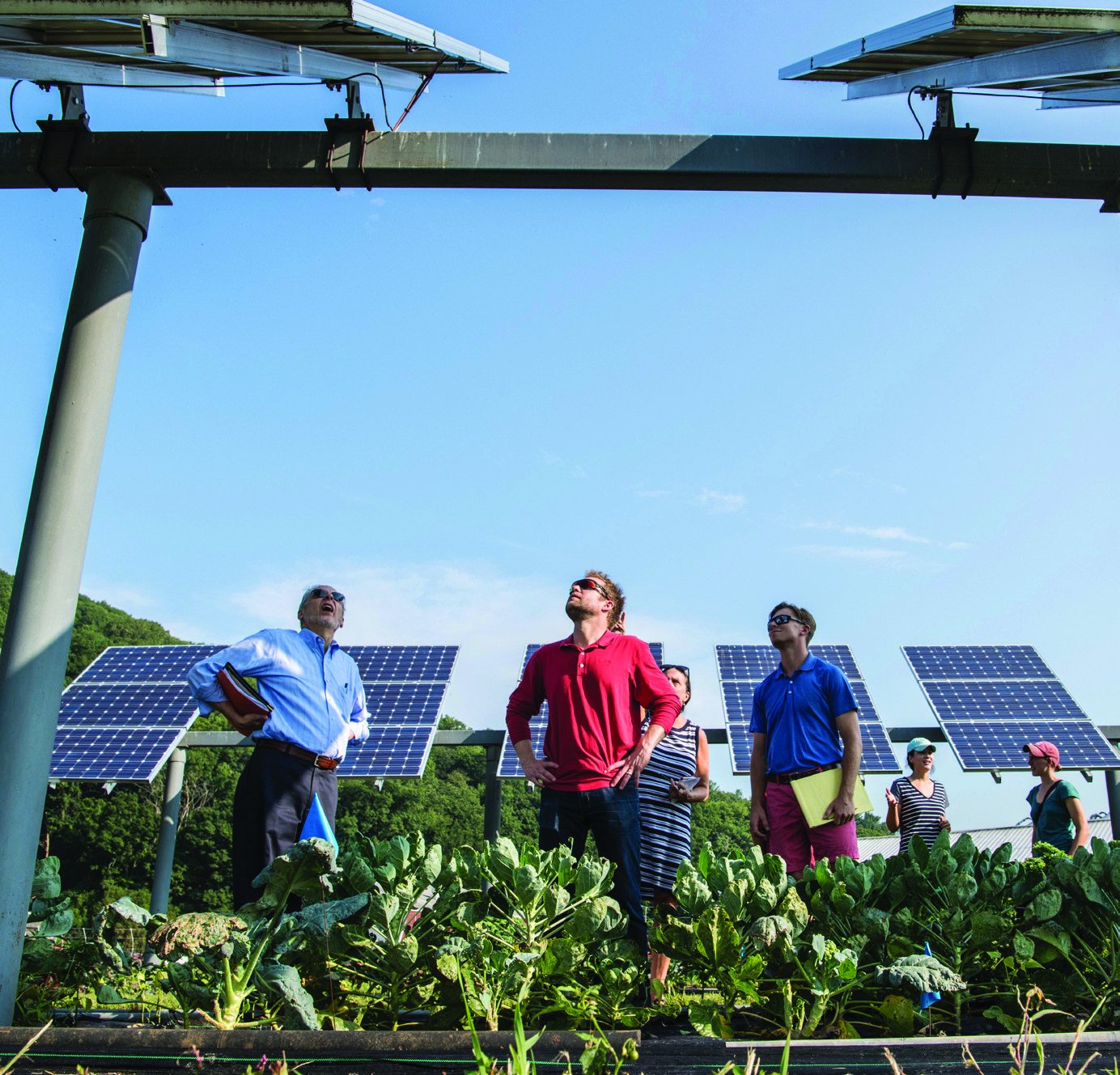
Community members looking up beneath solar panels above a vegetable garden
The pillars of our work

Democracy & Rule of Law

We defend the institutions that hold power accountable by litigating, organizing, and advocating so that elections are fair and the law applies equally to everyone.

Civil & Human Rights

We defend the right to live with safety and dignity: to seek refuge, to make decisions about one’s own body, and to live free from criminalization.

Climate Change & Environmental Justice

We accelerate a just transition to clean energy, putting legal power behind frontline communities so they share in its benefits and can withstand a changing climate.

10 Years of Impact
by the Numbers

300,110pro bono hours mobilized
$213.9Mworth of pro bono legal services donated
10,046volunteers mobilized for L4GG pro bono opportunities
32,248lawyers have taken advocacy actions with L4GG
172pro bono partners from law firms and corporate legal departments
44,157clients assisted from all 50 states across all programs
What Sets L4GG Apart

Pro Bono Mobilization at Scale

Since 2016, L4GG has acted on a simple conviction: lawyers are uniquely equipped to solve some of the most urgent problems of our time. They are trained in how laws are drafted, interpreted, and enforced. They take an oath to the Constitution and are bound by professional duties of honesty and integrity.

Belonging to the legal profession is a privilege, and a responsibility. But conviction alone is not enough to create real change. Lawyers need direction, training, and infrastructure to turn their skills into action, especially as we confront the erosion of democracy and the predominance of corruption. That is what L4GG provides.

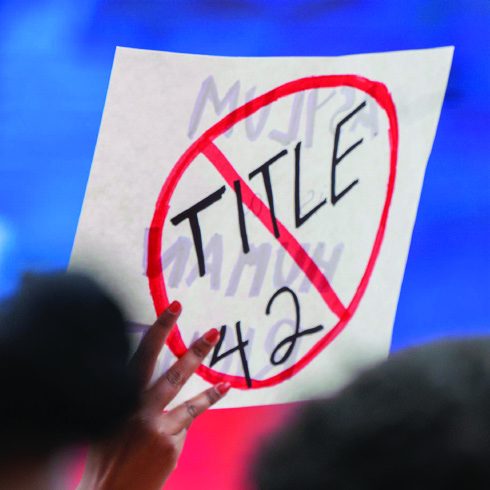
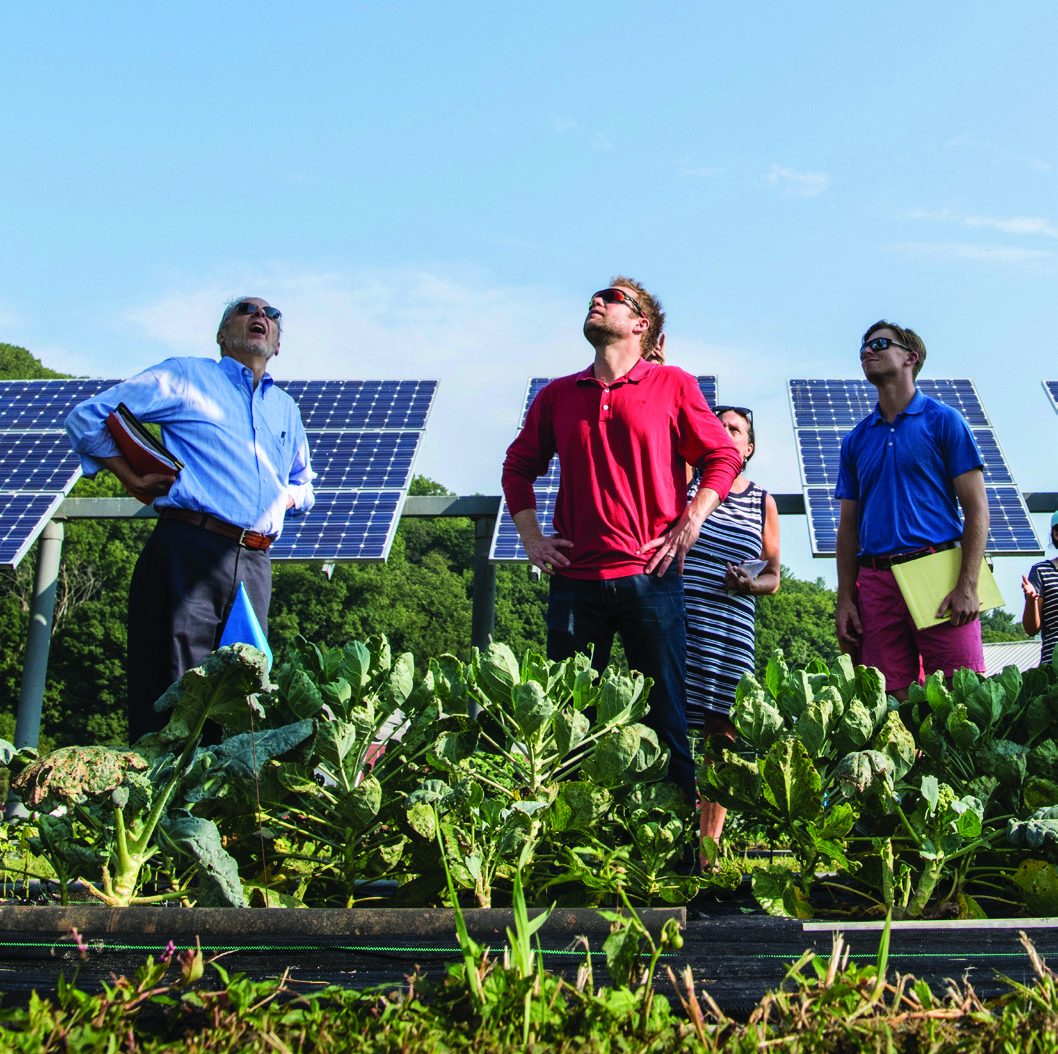
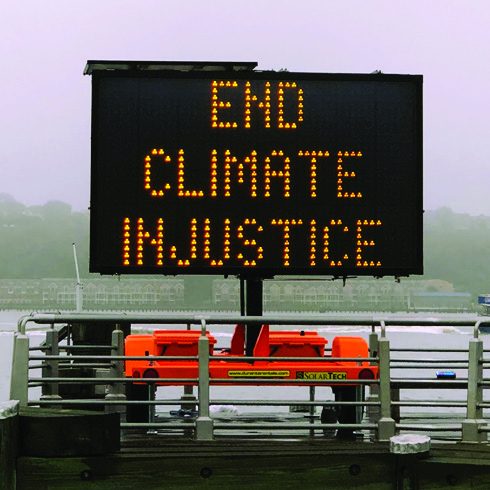
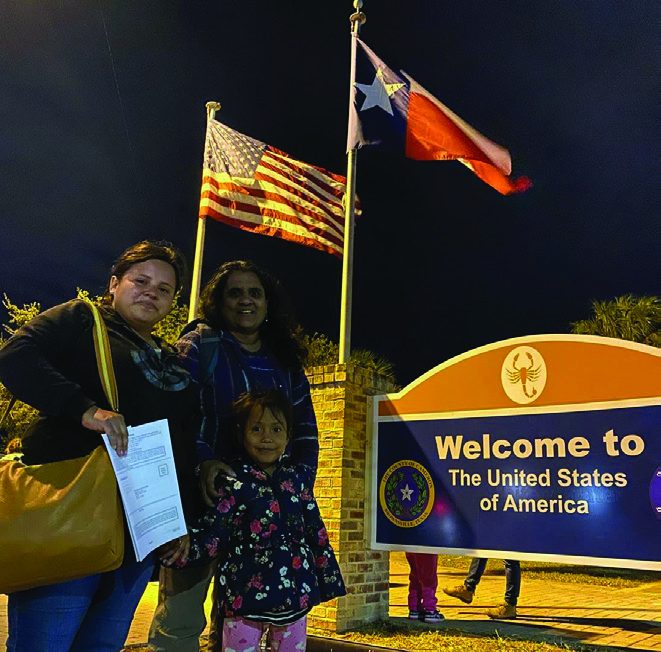
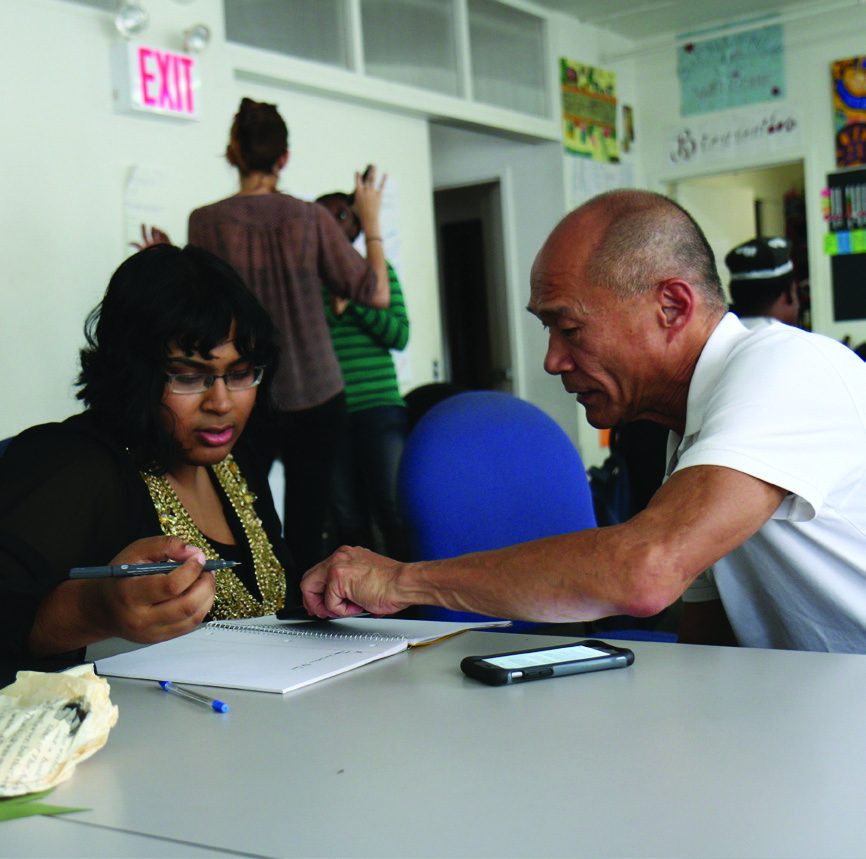
A protester holding a Title 42 signVolunteers beneath solar panelsSign reading End Climate InjusticeA family beside a Welcome to the United States signA lawyer helping a client at an intake tableA young farmworker

Our Distinctive Organizational Model

L4GG’s distinctive organizing model has emerged over 10 years of strategic bets, fast pivots, cutting-edge technology, and honest lessons from our wins and our losses. As a result, we have transformed how lawyers engage with the most critical social justice challenges of our time.

L4GG operates through four interconnected approaches, each powered by our national network of pro bono attorneys to multiply our impact.

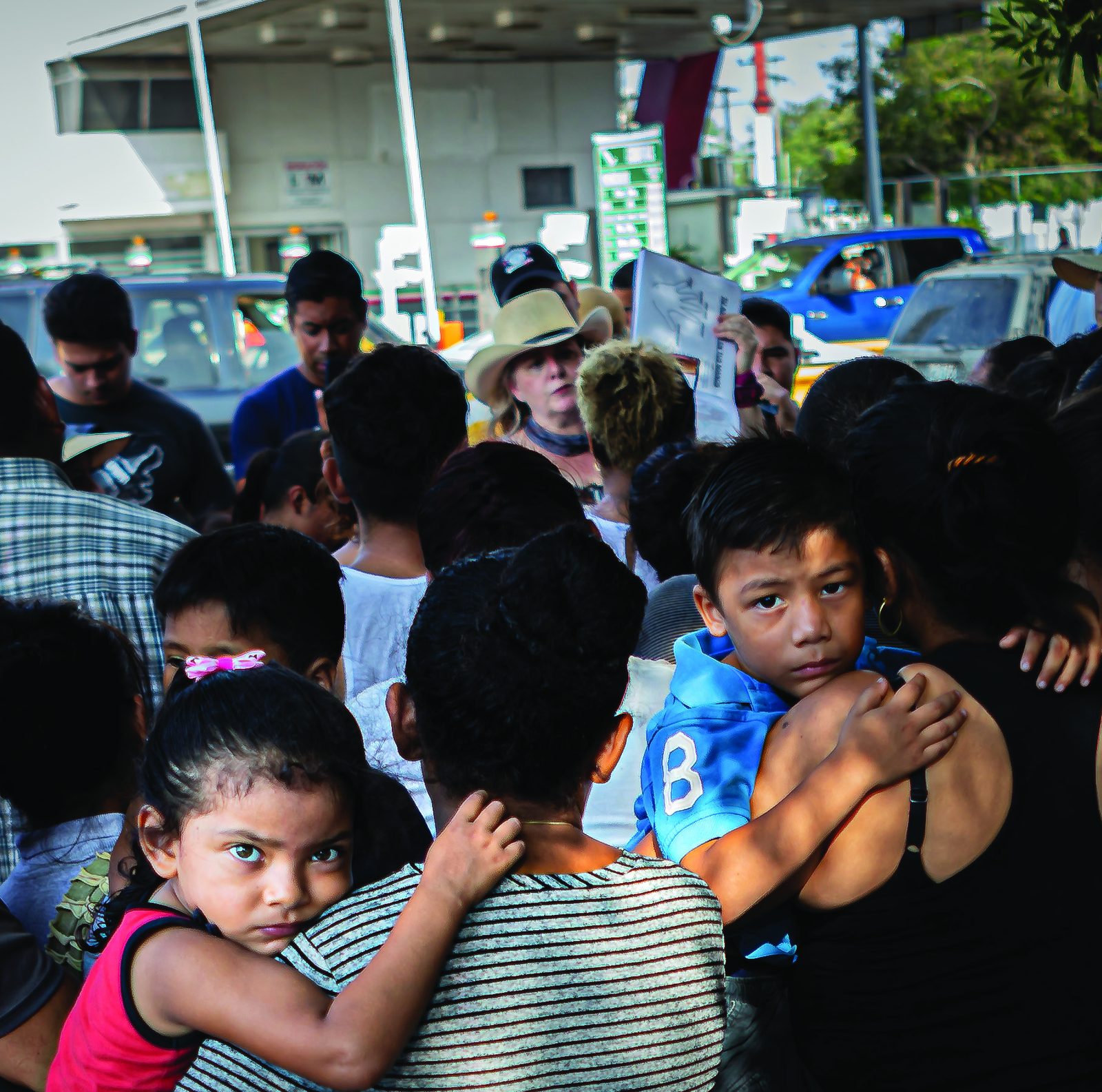
Families gathered at the U.S.–Mexico border
  1. Direct Legal Services

    When a crisis hits, we respond fast. We rapidly stand up clinics and pro bono programs that connect people, communities, and local governments with trained volunteer lawyers for legal consultations, clinic services, and full representation. Our technology platforms make remote legal assistance possible anywhere in the country, so thousands of attorneys who could not otherwise volunteer can step in when it matters most.

  2. Strategic Impact Litigation

    Our Pro Bono Litigation Corps mobilizes experienced, independent attorneys to serve as lead or co-counsel on high-impact cases challenging unlawful government action. The depth of expertise in our network directly addresses a critical shortage of qualified representation for people and causes desperately in need of a lawyer.

  3. Policy Advocacy and Education

    We give lawyers, advocates, and policymakers the knowledge to shape fairer laws. Our attorney-verified policy hubs and 50-state legal research reports track the law as it changes. Our training programs prepare lawyers to advocate in their own statehouses, and we draft model legislation and advocate directly for better state and federal policy.

  4. Organizational Capacity Building

    We fill infrastructure gaps and act as a force-multiplier for frontline organizations that lack in-depth legal or pro bono support. We provide legal research, technology, volunteer management, expert training, and scalable pro bono program design, so local groups can serve more people when crises hit.

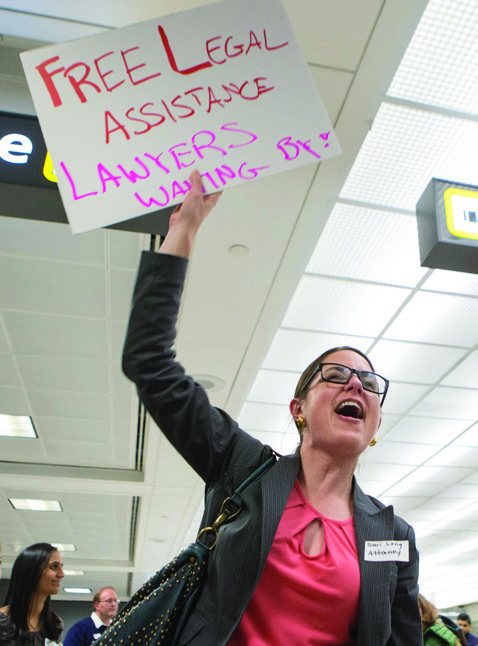
A volunteer attorney cheering and holding a “Free legal assistance — lawyers waiting” sign at an airport arrivals hall

L4GG from 2016–2026

  1. 2016
  2. Election Day

  3. Traci Feit Love posts a Facebook message

  4. Nearly 14,000 members in the Facebook group

  5. Survey & naming

  6. Working groups and committees start forming

  7. More than 125,000 lawyers join the group

  8. New name

  9. Tens of thousands of lawyers give feedback and support to evolve from a social media community into a nonprofit

  10. Founding board of directors announced

  11. 2017
  12. L4GG hires staff member No. 1: Traci Feit Love as Executive Director

  13. 501(c)(4) formed

  14. Women’s March & Rise Above, a two-day conference for 1,000+ attendees

  15. Trump signs first EO: “the Muslim ban” & “airport lawyers” start showing up

  16. L4GG organizing call

  17. Trump announces intention to withdraw from the Paris Agreement

  18. CCEJ program launch

  19. Trump rescinds DACA

  20. 72 hours training 1,500 lawyers to help immigration organizations meet the 2017 renewal deadline for thousands of Dreamers

  21. 2018
  22. Project Corazon founded

  23. Project Corazon Travel Fund established

  24. Mobilized 212 lawyers to provide legal representation to 1,568 asylum seekers detained at Karnes Detention Center in Texas

  25. Present legal resources for cities to reach 100% renewable energy at the Global Climate Summit in San Francisco

  26. 2019
  27. Weekend pro bono legal assistance commences at the Matamoros, MX/Brownsville border in response to the “Remain in Mexico” policy

  28. Established full-time Matamoros Clinic for asylum seekers

  29. Closed out the year with 6 full-time staff members

  30. 2020
  31. Launch of the COVID-19 Small Business Remote Legal Clinic pilot in New York City with the City Bar Justice Center and Kirkland & Ellis

  32. Clinics expand to 11 states, with 932 pro bono attorneys from 114 firms

  33. Closed out the year with 7 full-time staff members

  34. 2021
  35. 2,291 lawyers from 145 firms and legal departments assisted 25,000+ individuals

  36. Closed out the year with 10 full-time staff members

  37. 2022
  38. Pro bono audit: 23,700+ hours and $20M+ in legal services from 1,600+ volunteers at 100+ law firms

  39. 2023
  40. Pro bono audit: $25M in services as 1,314 volunteer attorneys contribute 41,572 hours

  41. 2024
  42. 55,191 pro bono hours valued at $32.4M+ from 1,548 volunteer attorneys and 67 law firms

  43. 2025
  44. Impact Docket launches, with bi-weekly actions lawyers can take

  45. Pro Bono Litigation Corps launches

  46. $50M in pro bono legal services deployed as political pressure sidelines nearly $1 billion in traditional capacity

  47. 2026
  48. Impact Docket goes weekly

  49. More than 60 full-time staff, and on track to mobilize more than $60M in donated legal services

Impact Docket

Reaching Thousands of Lawyers with the Impact Docket

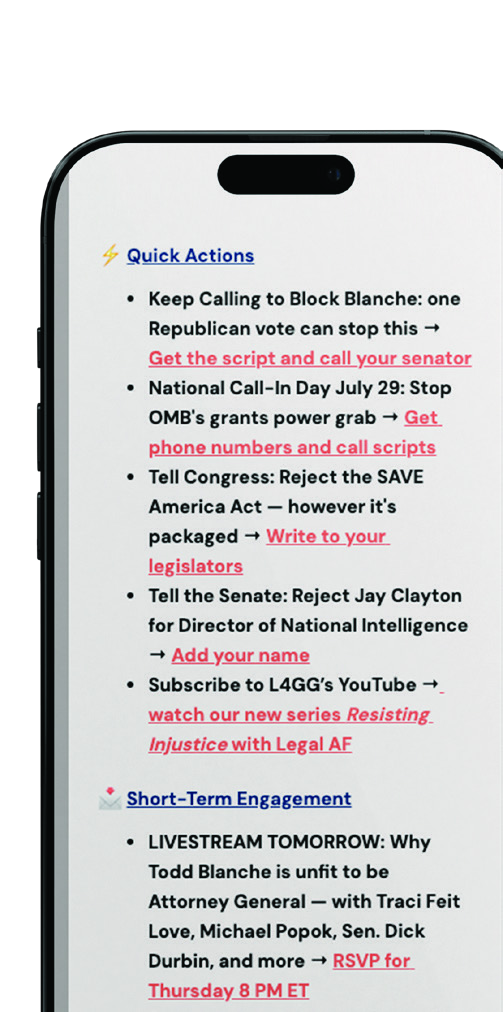
The Impact Docket is L4GG’s weekly action newsletter, published by the L4GG Action Fund. Each issue gives lawyers, law students, and advocates a short list of concrete ways to respond to the week’s most urgent threats to democracy, civil rights, and the environment. Actions range from two-minute letters to Congress and public comments on federal rules, to long-term pro bono and volunteer roles with L4GG and its partners.

It launched in February 2025 as a biweekly email and went weekly in March 2026. At 60 issues and counting, it has reached inboxes more than 2 million times. In the first seven months of 2026 alone, letter campaigns featured in the Docket generated more than 10,000 letters to Congress.

The Impact Docket has been viewed more than 296,000 times by almost 47,500 lawyers.

A phone showing the weekly Impact Docket email: quick actions and short-term engagement
Case study

Filling the Gap in Solar for All

When the Environmental Protection Agency terminated the $7 billion Solar for All program in 2025, primary grantees quickly moved to fight it in court. But many solar nonprofits, businesses, and individuals harmed by the shutdown weren’t grantees, and no one was representing them.

That’s the gap the Pro Bono Litigation Corps was built to fill: It doesn’t just put sidelined lawyers to work, it brings the cases no one else is bringing. In October 2025, with the Conservation Law Foundation, Southern Environmental Law Center, and the Lawyers’ Committee for Rhode Island, we sued on their behalf. On September 18, 2026, the court held EPA’s action unlawful and vacated the program-wide termination. If the ruling stands, Solar for All can resume nationwide.

Case study

Mobilizing Lawyers to Represent Asylum Seekers

During the 2018 family separation crisis, thousands of migrants were being detained at Karnes Detention Center south of San Antonio. Each faced a credible fear interview, the first and often decisive step toward asylum. Having a lawyer can mean the difference between safety and deportation.

RAICES, the Texas immigrant legal services organization, was overwhelmed. Often it had just 24 to 48 hours between a person’s arrival at the detention center and their interview, far too little time to find a lawyer for everyone who needed one.

L4GG built an answer in weeks. We recruited a cohort of 41 law firms, and together with RAICES we trained 282 attorneys to represent clients in remote credible fear interviews. Attorneys went on call, and L4GG’s custom technology matched each new case to a ready lawyer within hours.

In a six-month period, 212 volunteer attorneys represented 1,568 detained asylum seekers. A local crisis became a national response and a model we have used ever since.

Case study

Scaling Remote Legal Clinics for Businesses During COVID

When the COVID-19 pandemic hit, small businesses and nonprofits faced a wave of legal questions, including how to access emergency government aid, renegotiate leases they could no longer afford, and comply with new health regulations. Many businesses faced the prospect of shutting down for good, and few could afford private legal counsel.

At the same time, local legal services organizations wanted to help but had no capacity to build a program overnight and little experience delivering legal services remotely.

L4GG did. We had spent years running remote representation in the immigration context, so we built a clinic in three weeks. We launched in New York City in April 2020, then added a new state every few weeks until 11 were up and running, from Alaska to Florida.

In each state, a local legal services partner reached clients and a lead law firm supervised the substantive local law. Our technology platform took in thousands of requests and matched each requester to an attorney we had trained.

In all, 932 pro bono attorneys from 114 firms and corporate legal departments helped 2,149 small businesses and nonprofits, providing more than $2,500,000 in legal fees.

Democracy & Rule of Law

Democracy depends on institutions that hold power accountable and laws that apply equally to everyone. When those foundations are under attack, lawyers have a unique responsibility to defend them, and L4GG gives them the tools to do it.

Our goals are to ensure that critical constitutional challenges have qualified legal representation; to strengthen lawyers’ ability to shape fair and just policy in state legislatures; and to unite the legal profession in defense of the rule of law and fair elections.

We achieve these goals through our Pro Bono Litigation Corps, which equips independent attorneys to litigate high-impact cases; training and leadership programs that prepare lawyers for state legislative advocacy; election protection programs that put trained lawyers in the field during voting; and national organizing that unites the legal profession in the defense of the rule of law.

  1. 2017
  2. L4GG Action Fund organizes an open letter from 1,900 lawyers opposing the Jeff Sessions nomination as Attorney General

  3. 2018
  4. Volunteers hand deliver a petition from 1,500 lawyers to key members of Congress demanding protection of the Mueller Investigation

  5. 2020
  6. L4GG Action Fund organizes 5,000+ lawyers signing an open letter opposing the Supreme Court nomination of Amy Coney Barrett over civil rights concerns

  7. 2021
  8. L4GG Action Fund organizes 12,000 lawyers and advocates signing an open letter calling for President Trump’s impeachment and removal after the U.S. Capitol attack

  9. 2022
  10. State Legislative Advocacy Academy launches; 293 lawyers join and access 9 training modules by year-end

  11. 2023
  12. 40 lawyers and law students graduate from the Academy

  13. 20 changemakers selected for the first SLAA Leadership Program

  14. 2024
  15. Good Government Voter Guides released: 34 Senate and 11 gubernatorial races

  16. 2025
  17. Law Day of Action: 700+ lawyers and advocates gather at the U.S. Supreme Court, with events in 50+ cities and 10,000+ participants

  18. Nearly 700 people send 1,500+ letters about a DOGE investigation

  19. Files first impact litigation as co-counsel for environmental nonprofits whose grants were unlawfully terminated

  20. Pro Bono Litigation Corps founded; L4GG co-founds the Nation of Laws coalition to organize lawyers in support of the rule of law and judicial independence

  21. 2026
  22. Settlement protects the private medical information of 3,000+ trans youth from an abusive federal subpoena

  23. State Legislative Advocacy Academy relaunches; ~400 people register by year-end

  24. Impact Docket moves from biweekly to weekly

  25. First pilot state chapter launches in Michigan

  26. Habeas corpus relief granted for two detainees in PBLC’s first immigration habeas case; a dozen more filed since

  27. Law Day of Action: 75+ events in 66 cities and 26 states, with 3,000+ participants

  28. Court rules EPA illegally terminated the $7B Solar for All program; L4GG serves as co-counsel

  29. “Block Blanche” sign-on letter gathers 3,500+ signatories and is delivered to Senate Judiciary Committee members and staff

  30. First Nation of Laws Rule of Law Summit in DC, with 30+ organizations represented

  31. L4GG Action Fund engages on state ballot initiatives on impartial courts and civil and human rights in KS, MO, MT and CO

  32. Leadership Program relaunches with 21 participants from 15 states

  33. First election protection programs launch in Michigan, Georgia, Virginia and Texas

  34. PBLC settlement restores a federal funding offer to the Underground Railroad Education Project

Democracy & Rule of Law

Pro Bono Litigation Corps

When traditional pro bono channels face unprecedented pressure, the Pro Bono Litigation Corps provides independent attorneys with infrastructure, resources, and partnerships to take on high-impact constitutional matters.

Impossible

When the Trump administration began targeting law firms through executive orders in 2025, it created a chilling effect on the pro bono industry. With law firms fearful of being targeted, many became less likely to take on cases that challenged the administration, restricting access to justice for vulnerable populations and leaving important social impact cases without qualified representation.

At the same time, many retired, solo, or otherwise experienced litigators had the desire to serve on these cases. However, without the infrastructure that a law firm provides, such as malpractice insurance and access to legal research tools, they couldn’t serve on impact litigation cases.

Possible

Lawyers for Good Government closed the gap by launching the Pro Bono Litigation Corps. We began giving independent litigators everything a firm would: malpractice insurance, secure docketing, access to legal research tools, paralegal support, and supervision by L4GG attorneys. More than 700 litigators have joined, and they’re winning. They have helped shield the medical records of more than 3,000 transgender youth from a federal subpoena, secured the ruling that the EPA’s termination of the $7 billion Solar for All program was unlawful, and taken on the Pentagon’s retaliatory firing of Stars and Stripes journalists.

Repeatable & Scalable

With a volunteer pool of more than 700 qualified pro bono litigators with a variety of subject matter backgrounds, the PBLC is able to take on cases on a wide variety of issues. We have the infrastructure in place and draw from our network of experts as needed for different cases.

As we add more in-house attorneys to the L4GG team, we can mobilize even more pro bono attorneys for impact litigation cases. The ability to be a force-multiplier is a key piece of L4GG’s model: building systems that tap into the wealth of experience within our pro bono attorney network to move cases and issues forward.

The Statue of Liberty at sunset

“This is a moment that calls for unity and courage across legal practice lines. Whether you come from the plaintiffs bar or Big Law, if you’re ready to fight for the Constitution and uphold our legal institutions, the Pro Bono Litigation Corps is your place to do it.”

Jay Sadd
Pro Bono Litigation Corps by the numbers
59Clients assisted in PBLC’s first year
165Lawyers involved in PBLC’s first year
~800Volunteer lawyers who have expressed interest in becoming involved in litigation
$4.6MValue in pro bono services in PBLC’s first year
Democracy & Rule of Law

State Legislative Advocacy Academy and Leadership Program

The Academy and Leadership programs are designed to teach lawyers and law students how to use their skills to influence public policy in their home states.

Impossible

Across the country, basic civil and human rights are at stake in state legislatures, which have become the epicenter of policy change for a growing number of key issues. From abortion bans to censorship in our schools to attacks on the LGBTQ+ community, legislation that further marginalizes already vulnerable communities is on the rise at an alarming rate.

Legal skills to support grassroots advocacy in opposition to these unjust policies are in high demand, as activists and advocates work to support critical public policy battles at the state level. Coalition partners in the advocacy space have told L4GG time and time again that they need thoughtful, highly skilled, compassionate legal volunteers to help reach their legislative goals.

Possible

By nature of their work and training, lawyers already have the skills and expertise to make a difference in advocating for state-level policy changes. Lawyers’ high-caliber research, writing, analysis, and oral communication skills can be easily deployed within the legislative arena — but only when they have the proper guidance and training to do so.

Lawyers for Good Government bridged the gap between traditional legal education and advocacy training with the launch of the State Legislative Advocacy Academy (SLAA) in 2022. The first-of-its-kind training program provides tailored education to lawyers and law students on how to fight for systemic change for more equitable and just communities. The Academy focuses on educating a large cohort of lawyers and law students in a seven-course series, providing expert insight on the most effective ways for lawyers to use their skills to create policy change.

Repeatable & Scalable

Trainees receive a live curriculum so they can learn as a cohort. In addition, every session is recorded and published free online, so each year’s materials can become an asynchronous resource that is accessible year-round. More than 1,500 lawyers have participated in the SLAA training modules, and hundreds of them have graduated with a certificate.

New and timely content is easily added to the curriculum based on each year’s needs. For example, in 2026 we added sessions on redistricting and citizen-led ballot measures. For lawyers ready to go further, our Leadership Program takes SLAA graduates from trained volunteers to movement leaders, equipping them to lead advocacy campaigns in their home state.

A lawyer helping a client at an intake table

“I absolutely love what I am learning. … I’ve been able to teach my Resist Through Action group I started after the election some of what I’ve learned, in addition to other info I’ve gathered/learned, and we are now a group taking regular action during this national mess, both in our state and nationally. Thank you!”

Blair Moses, Leadership Program Participant
State Legislative Advocacy by the numbers
1,502Lawyers involved
79Participants in the SLAA Leadership Program
21Leadership Program participants in 2026
15States represented in the 2026 Leadership Program
Democracy & Rule of Law

Law Day and Rule of Law Organizing

Lawyers across the country reaffirmed their oath to the Constitution in the largest gathering of its kind in history.

Impossible

In 2025, unprecedented attacks on the rule of law came from the top: executive orders punishing law firms for representing political opponents, impeachment threats against judges, open defiance of court orders, and public intimidation of lawyers. The profession sworn to uphold the Constitution was under direct attack, with no unified way to answer.

Possible

In a matter of weeks, L4GG and the Bar Association of San Francisco built a coalition of more than 150 bar associations and legal affinity groups. L4GG gave local groups the digital infrastructure and organizing support to host their own events. In May 2025, the National Law Day of Action brought more than 10,000 legal professionals to courthouses in more than 50 cities to publicly reaffirm their oath to the Constitution. Law Day was the nation’s largest gathering of its kind in history, uniting lawyers, judges, and legal professionals in a powerful demonstration of the legal community’s commitment to democracy.

L4GG produced the flagship event in Washington D.C. on the steps of the Supreme Court, where 600+ legal professionals heard from speakers including Wiley Adams, President of the National Bar Association, and Representative Jamie Raskin. Simultaneously, thousands more gathered at courthouses across the country — from New York City, which saw 2,000 participants, to San Francisco, which welcomed 1,200 gatherers, to rural communities, where dozens showed up — creating a truly nationwide movement.

Repeatable & Scalable

Law Day proved the legal profession can move as one when the infrastructure exists. We’ve since held a second National Law Day of Action, helped organize the leaders into a standing coalition known as the Nation of Laws Coalition, and helped organize the first Nation of Laws in-person summit in July of 2026, where dozens of legal leaders gathered to prepare for and pressure test threats to the midterm elections. Each mobilization grows the coalition and makes the next collective action faster and stronger.

Together, we are building a lasting professional counterweight to anti-democratic forces — one that transcends partisan divides and speaks with the unique moral authority of those sworn to uphold constitutional principles.

A crowd gathered in support of legal assistance

“A nation governed by laws, not the whims of those in power, cannot survive when the executive branch transforms the justice system into an instrument of political retribution.”

Nation of Laws Coalition, September 23, 2025
Law Day and Rule of Law Organizing by the numbers
12,000Lawyers and advocates called for President Trump’s impeachment and removal after the 2021 insurrection
78Unique cities hosted a total of 132 Law Day events in 2025 and 2026
640+Lawyers mobilized to protect the 2026 midterm elections
1,502Lawyers trained in the State Legislative Advocacy Academy
79Leaders coached in the Leadership Program since 2023

Civil & Human Rights

Every person deserves due process, safety, and the freedom to make decisions about their own body. When those rights are under attack, L4GG makes sure no one faces a hostile legal system alone.

For migrants and asylum seekers we provide bilingual legal guidance and legal representation, backed by a standing bench of pro bono attorneys ready to deploy to detention centers, conduct intake, and provide counsel. Our pro bono litigators file habeas petitions and fight for the release of detained clients.

To protect bodily autonomy, we build free, attorney-verified policy hubs that track reproductive and transgender health laws in every state, giving providers, patients, and advocates reliable information as laws change. We also help design and implement protective legislation and litigate to protect access to care.

  1. 2017
  2. Responds to the Muslim Ban, deploying hundreds of attorneys to airports

  3. Mobilizes 5,400+ lawyers after the rescission of DACA; 1,500+ trained in 72 hours

  4. 2018
  5. Project Corazon founded with support from nearly 40 large law firms

  6. Remote representation project with RAICES: 212 lawyers from 41 firms represent 1,568 asylum seekers at Karnes

  7. Project Corazon Travel Fund launches to cover travel for volunteer lawyers

  8. 2019
  9. 100+ lawyers from 13 firms assist 50+ detainees after ICE raids on Mississippi poultry plants

  10. Launches the only full-time legal clinic for asylum seekers at the Matamoros/Brownsville crossing

  11. 2020
  12. Lawyers for Racial Justice launches to research legal frameworks contributing to systemic racism

  13. 2021
  14. Project Corazon oversees MPP wind-down; humanitarian parole secured for 1,789 asylum seekers

  15. Lawyers for Racial Justice releases a report on paid leave to vote

  16. “Child Farmworkers: Too Young, Vulnerable, & Unprotected” published with a model policy

  17. Work Permit Pro Bono Project helps 100+ asylum seekers in its first two months

  18. 2022
  19. 1,347 asylum seekers secure U.S. entry; 200+ Ukrainian nationals and families receive temporary security

  20. 40+ law firms and partners help publish 6 reports and policy recommendations

  21. Reproductive Health Legal Assistance Project launches, mobilizing 500+ volunteers across 56 states and territories

  22. 2023
  23. Bi-weekly Reproductive Health Digest launches

  24. Maryland signs an executive order protecting transgender individuals, with input from L4GG and partners

  25. Policy Resource Hub for Reproductive Health launches

  26. 2024
  27. LGBTQ+ Asylum Clinic opens in New York City

  28. Hospital Model Policies Project announced, starting in Georgia

  29. 2025
  30. Work permit legal clinics launch with law firms

  31. Policy Resource Hub for Transgender Rights launches

  32. 2026
  33. Detention Bridge Project launches a nationwide public database on ICE detention conditions

Civil & Human Rights

Defending the Rights of Migrants Through Project Corazón

Through pro bono legal representation, strategic litigation, and a variety of partnerships, we strive for justice and dignity for every person seeking safety in the U.S.

Impossible

In 2018, families were being torn apart at the southern border. Parents and children seeking asylum were thrown into one of the most complex legal systems in the country, with no right to a court-appointed lawyer. The few immigration attorneys available were concentrated in cities, far from the remote detention centers and border towns where people were being held. Most faced the system alone, at the very moment a lawyer could mean the difference between safety and deportation.

Possible

Within weeks of the family separation crisis, L4GG launched Project Corazón in partnership with RAICES, the Texas immigrant legal services organization. In less than six months, we mobilized 212 lawyers from 41 law firms to represent 1,568 detained asylum seekers in their credible fear interviews.

That collaboration became the foundation for everything after. We put lawyers on the ground in the Rio Grande Valley, where our full-time clinic at the Texas-Mexico border served more than 10,000 people.

But one-to-one help could never match the scale of the need, so we kept building. We created Spanish-language legal education that reached migrants before they arrived; our 2023 livestreams alone drew 39,000+ viewers. We built remote clinics that followed clients wherever they settled and pop-up clinics for LGBTQ+ asylum seekers in New York. When mass detention surged in 2026, we partnered with Estrella del Paso at Fort Bliss, Texas, and took on more than 120 referrals in less than three months. Our Pro Bono Litigation Corps has now started filing habeas petitions for detained clients, winning releases for almost all of them.

Repeatable & Scalable

Eight years of crisis response taught us that attacks on immigrants are designed to move more quickly than local legal services providers can grow. So we built a system that moves even faster.

Project Corazón keeps a standing bench of nearly 600 trained attorneys, including more than 150 who are ready to travel to detention centers. When a new crisis hits, we activate them as surge capacity for local organizations, strengthening the groups already on the ground rather than parachuting in. Clients who enter through Project Corazón can access the rest of L4GG’s services, from habeas litigation to other specialized help.

A family beside a Welcome to the United States sign
Project Corazón by the numbers
10,000+People served at our full-time clinic at the Texas-Mexico border
1,568Detained asylum seekers represented in credible fear interviews
39,000+Viewers of our 2023 Spanish-language livestreams
300Work permit applications completed through the Work Permit Pro Bono Project
400LGBTQ+ asylum seekers trained to navigate the asylum process through the LGBTQ+ Asylum Clinic
120+Attorneys trained and deployed through Detention Bridge
Civil & Human Rights

Gender Justice and Health Equity

Our suite of resources is updated daily to provide legal clarity, timely analysis, and practical tools for advocates, providers, and policymakers.

Impossible

Since the Supreme Court’s June 2022 decision overturning Roe v. Wade, state abortion laws have continually changed, leaving an unclear and unreliable legal landscape. Many state laws were written quickly and in broad, non-medical terms, causing fear and confusion among providers, patients, and the public. As a result, doctors hesitated to treat patients, patients didn’t know their rights, and advocates worked from outdated information while lives were on the line.

Possible

There was an urgent need for reliable, up-to-date legal information that could help providers, patients, advocates, and policymakers understand and respond to rapidly changing laws. L4GG built the Policy Resource Hub for Reproductive Rights, a free, attorney-verified tracker of reproductive health law in every state and territory, updated every business day.

More than 1,000 pro bono attorneys from more than 50 law firms and corporations power the hub. No single organization could manage a research operation of this size without significant in-house staffing. Providers, patients, advocates, and policymakers now have one trusted place to learn what the law says today, as the law evolves.

Repeatable & Scalable

When attacks on transgender people escalated in 2025, we didn’t start from scratch. In late 2025 we launched the Policy Resource Hubs for Transgender Rights built on the same framework, technology, and volunteer infrastructure. Together, the hubs have drawn more than 42,000 views.

The same legal muscle now powers direct defense: With our Pro Bono Litigation Corps, we helped protect medical records for more than 3,000 transgender youth from an overreaching federal subpoena. We also helped design and implement New Jersey’s shield law, which protects providers and patients providing transgender and reproductive health care from out-of-state prosecution.

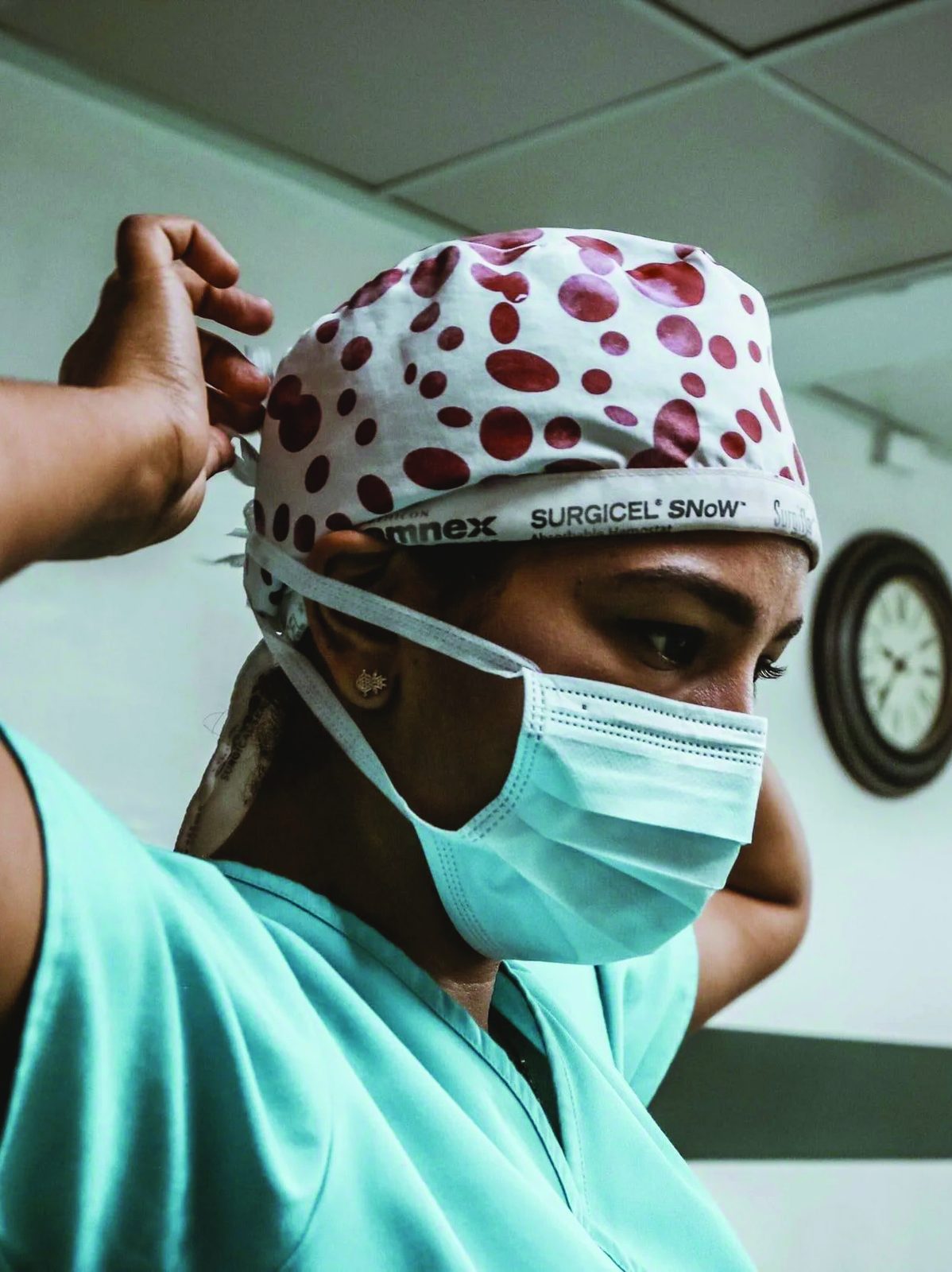
A health care worker tying on a surgical cap and mask
Gender Justice and Health Equity by the numbers
19,598Times Reproductive Health Hub resources have been viewed since 2022
2,201Lawyers trained for the Reproductive Health Hub
53Law firms and companies participated in the Reproductive Health Hub
17,900Times Trans Rights Hub resources have been viewed since 2025
811Lawyers trained for the Trans Rights Hub
31Law firms and companies participated in the Trans Rights Hub

Climate & Environmental Justice

The climate crisis demands skilled, committed, legal intervention from those who understand the stakes. L4GG mobilizes legal expertise to accelerate a just transition to a green economy.

Our goals are to expedite the shift to clean energy at the state, local, and community level; help under-resourced communities win, protect, and implement federal funding for climate projects; and to directly assist communities to secure access to clean, affordable drinking water.

We achieve these goals by providing services – including online legal clinics to help clients and train attorneys, and online navigators to identify federal funding opportunities for climate-related projects – and extensive legal research on clean energy and environmental equity.

  1. 2017
  2. Climate Change Program established in response to the U.S. withdrawal from the Paris Accord

  3. 2018
  4. First three State Profiles (CO, MN, MO) presented to 200+ local decision-makers at the Global Climate Summit in San Francisco

  5. 2020
  6. Partners with Great Lakes Environmental Law Center on clean drinking water and Midwest Environmental Advocates on tribal treaty rights

  7. 2021
  8. 42 municipalities from 24 states trained on renewable energy tools such as VPPAs

  9. 2022
  10. 700+ communities from 25+ states trained on federal climate funding

  11. Disadvantaged Communities Report published, defining “disadvantaged community” in every state

  12. 2023
  13. Green and Equitable Communities Clinic launches; 6 webinars reach 600 municipalities in 25 states

  14. Indiana NAACP gains intervenor status in EV infrastructure proceedings with L4GG’s legal assistance

  15. Report on the Benton Harbor water crisis produced with the Community Water Council

  16. 2024
  17. Partners with the State of Washington to help communities plan and file for IRA tax credits; nearly 1,000 projects assisted and 28,000 tons of GHG reduction

  18. Clean Energy Tax Navigator launches for under-resourced communities

  19. Partnership with Giraffe Financial simplifies clean energy tax credit filing

  20. 2025
  21. Federal Fund Protection Initiative defends $60B+ in terminated grants and $80B+ in delayed or paused federal climate funding, supporting 600 entities across 47 states and 4 territories

  22. 400+ additional lawyers recruited for the Fund Protection Clinic, which defends $50B in federal climate funding for 600+ communities with PBLC support

  23. Lighthouse Cohort wraps up: 40+ local governments assisted and 27 file for federal tax credits

  24. Court of Federal Claims Clinic launches, offering fully remote help in all 50 states and 4 territories

  25. Class action filed over EPA’s termination of the $2.8B Environmental and Climate Justice Grant Program

  26. Emergency injunction denied in the Section 138 case

  27. L4GG appeals the denied injunction in the Section 138 case

  28. Elective Pay Sprint Hub launches, giving 300+ nonprofits, local governments and religious institutions free legal help on tax credits and green finance, and cutting an estimated 107,000 tons of CO2

  29. 2026
  30. First Court of Federal Claims case filed for a client whose environmental justice grant was unlawfully terminated

  31. First Court of Federal Claims case filed for a client whose environmental justice grant was unlawfully terminated

Climate & Environmental Justice

Fund Access to Combat Climate Change and Promote Clean Energy

Under-resourced communities get guidance and legal support to obtain, maintain, and implement federal funding for climate projects.

Impossible

The passage of the Infrastructure Investment and Jobs Act (IIJA) in 2021 and the Inflation Reduction Act (IRA) in 2022 was the largest investment in climate action in American history. Hundreds of billions of dollars were on the table to build clean energy infrastructure, make communities more resilient against climate disasters, clean up polluted neighborhoods, and create good jobs. The communities hit hardest by pollution and climate change were meant to be first in line — in theory.

In practice, however, the money was locked away at the center of a maze. Grant programs came wrapped in dense federal rules. A new IRA provision, known as elective pay, let tax-exempt entities claim clean energy tax credits as cash, but almost no one knew how it worked.

Money for critical projects remained out of reach for communities and groups with the most at stake because they didn’t have the expertise or the budget to navigate labyrinthine processes.

Possible

We saw the gap and moved into it. Through the Green and Equitable Communities Clinic, pro bono attorneys helped frontline communities win federal funding and stayed with them as projects broke ground. We also recognized a lane that almost no one else was filling, tax law, and deliberately built expertise in it. We started hands-on work with local governments, then turned what we learned into a tool anyone could use.

In July 2024, we launched the Clean Energy Tax Navigator, a free online tool that tells public entities and nonprofits whether their clean energy projects qualify for federal tax credits paid out as cash. More than 22,000 people have visited it so far. In Washington State, our work with the Department of Commerce helped public entities file for more than $13.5 million in federal tax credits.

Repeatable & Scalable

Every piece of this model was built to be reused. The Clean Energy Tax Navigator is free and self-service, so one tool can reach far more communities than any lawyer could alone. When a community needs more support, our Elective Pay Sprint Hub, backed by our network of volunteer attorneys and advocates, offers one-on-one help.

The delivery model has scaled from cities to whole states. In Washington State, we partnered with the Department of Commerce to bring tax credit support to public entities statewide. When federal funding became uncertain, we launched the Local Legal Support Initiative in Colorado, run in coordination with the governor’s office and the Department of Local Affairs, to offer free legal help to local governments, nonprofits, and Tribes. Now we’re adding green finance expertise to move forward the projects that can’t continue on credits alone.

Volunteers beneath solar panels
Fund Access by the numbers
$9.2MTotal tax credits received by L4GG clients through the Clean Energy Tax Assistance Program
$27.3MTotal tax credits filed for through the Clean Energy Tax Assistance Program
56,423Clean Energy Tax Navigator resource views
4,841Clients assisted through the Navigator and related resources
32Volunteer lawyers supported the Navigator and related resources
Climate & Environmental Justice

Fund Protection to Keep the Climate Change Fight and Clean Energy Alive

Our fund protection initiative offers safeguards for critical federal climate and environmental justice funding that is currently at risk.

Impossible

In January 2025, the second Trump administration wasted no time unlawfully withdrawing and freezing funds for climate projects in underserved and disadvantaged communities, for Tribal governments, and for nonprofits. Practically overnight, more than $35 billion in federal climate and environmental justice investments from the Inflation Reduction Act, Infrastructure Investment and Jobs Act, and other federal funding sources were under threat.

Fighting a federal grant termination means administrative appeals, strict closeout rules, and, often, litigation — all of which are daunting even in the best of times. Contesting terminations without a lawyer, against a government hostile to the very premise of your work, felt impossible.

For many grantees, their climate resilience and clean energy projects looked dead in the water.

Possible

We refused to accept that, and pro bono advocates became a lifeline for thwarted organizations and vulnerable communities. In January 2025, L4GG launched the Federal Fund Protection Initiative — a collaborative effort with the Environmental Protection Network, Natural Resources Defense Council, and other partners — to safeguard billions in critical federal climate and environmental justice funding. In March we added one-on-one pro bono support into the mix, and in December we launched the Court of Federal Claims clinic to help grantees seek monetary damages for the unlawful termination of funds.

What began as support for Environmental Protection Agency, Department of Energy, and Department of Agriculture grantees is now a full funding defense system. It covers legal expertise to defend against audits, investigations, and improper terminations; technical assistance to ensure compliance with grant requirements; strategic communications to build public and political support; and educational resources to navigate complex federal funding processes.

When the federal government slammed the door, we opened another one, so environmental justice funds reach the communities they were promised to.

Repeatable & Scalable

Terminations, freezes, and unlawful conditions are spreading across federal agencies, and OMB rulemaking now threatens more than $1 trillion in funding across sectors. We are scaling to match, with agency-by-agency research on financial assistance rules, compliance requirements, and pre-litigation procedures.

Health is next. We’re extending our playbook to Department of Health and Human Services grantees, Medicaid-dependent providers, Title X clinics and Planned Parenthood, reproductive and gender-affirming care providers, and grantees of the Federal Emergency Management Agency and the National Institutes of Health. The infrastructure is already built and pro bono attorneys are already trained, so we can respond the moment the need arrives.


A sign reading End Climate Injustice
Fund Protection by the numbers
$4.5BFunds protected
$99.3MTax credits unlocked by L4GG clients
$203.2MGrant funds recouped by L4GG clients
35,950Fund Protection Clinic resource views
816Clients assisted through the Fund Protection Clinic
170Volunteer lawyers supported the Fund Protection Clinic

Looking Ahead: A Just Future Is Possible

The next 10 years will demand more than crisis response. They will demand rebuilding the legal and civic infrastructure that makes good government possible — and making it strong enough to withstand whatever comes next.

L4GG enters this next chapter with something that did not exist 10 years ago. We have a national community of lawyers ready to act, the technology and expertise to mobilize them at scale, and a proven method for turning legal talent into lasting impact. Through strategic litigation, pro bono mobilization, policy advocacy, and partnerships that put legal power in the hands of communities on the front lines, we are ready to think even bigger over the next decade.

Our ambition is not simply to win the next case or launch the next program. It is to build a legal movement equal to the challenges we face in the decade ahead. This movement — which you are a part of — will defend democracy, protect human and civil rights, advance environmental justice, and help create good government for everyone.

Ten years ago, this organization was impossible. Today, a just future is within reach.

Call to Action

This movement runs on people. If you are a lawyer and you lend us your skills, we’ll give you the training, structure, and support to make them count. If you can give, your gift builds the infrastructure that lets thousands of lawyers act at once. And if you believe in this work, bring someone in: Send this report to a lawyer you know.

The need is enormous. The opportunity is bigger. For 10 years, we have proven what lawyers can do when we come together. Help us build what comes next.

Donate

With Gratitude for Our Supporters and Staff

An operation like Lawyers for Good Government isn’t impossible — but it takes a lot of good people who are exceptionally skilled. We offer profound gratitude to everyone who makes our strategic vision and our daily operations possible.

Board of Directors

L4GG and L4GG Action Fund

  • Traci Feit Love, President
  • Ted Jacobs, Chair and Treasurer
  • Adam S. Cohen, Vice Chair
  • Mark Friedman
  • Jacqueline Haberfeld
  • Dan Osheyack
  • Shelley Poticha
  • Rhea Ricard
Staff
  • Erin Baker
  • Lucas Bladen
  • Jillian Blanchard
  • Alexandria Brooks
  • Jaden Carter
  • Kunyu Ching
  • Katherine Christopher
  • Amilcar Cifuentes Luarte
  • Samara Cohen
  • Alexis Daniel
  • Jonathan Dinerstein
  • Ty Douglass
  • Emily Dulcan
  • Stephanie Fitzgerald
  • Camilla Getz
  • Melanie Gleason
  • Rose Goodbread
  • Mandy Hagseth
  • Ryan Hathaway
  • Sterling Howard
  • Meyling Jean Gilles
  • Rachel Johnson
  • Carol Khalil
  • Laura Klein
  • Larissa Koehler
  • Corinne Krupp
  • Amy Lamson
  • Hema Lochan
  • Traci Love
  • Sindy Mata
  • Zane McNeill
  • Kelly McRae
  • Aaron Meyer
  • Baileigh Millender
  • Alyssa Morrison
  • Bria Nelson
  • Yasmine Oubahi
  • Nicholas Pacifico
  • Enrica Pangrazi
  • Minho Park
  • Nestor Perez
  • Pamela Perry
  • Amy Powell
  • Suhayla Purscelley
  • Jessica Riley
  • Allison Rogers
  • Joseph Seif
  • Amy Senier
  • Allison Sewalt
  • Khadijah Silver
  • Stacy Simons
  • Melanie Smith
  • Alexandra Solomon
  • Neha Srinivasan
  • Jose Villalobos
  • Danielle West
  • Kadison Willis
  • Kyra Wilmes
  • Lauren Worsek
  • Tina Yates
  • Edward Yim
  • Zenab Youssef
  • Elizabeth Zambrana
  • Andrii Zubar